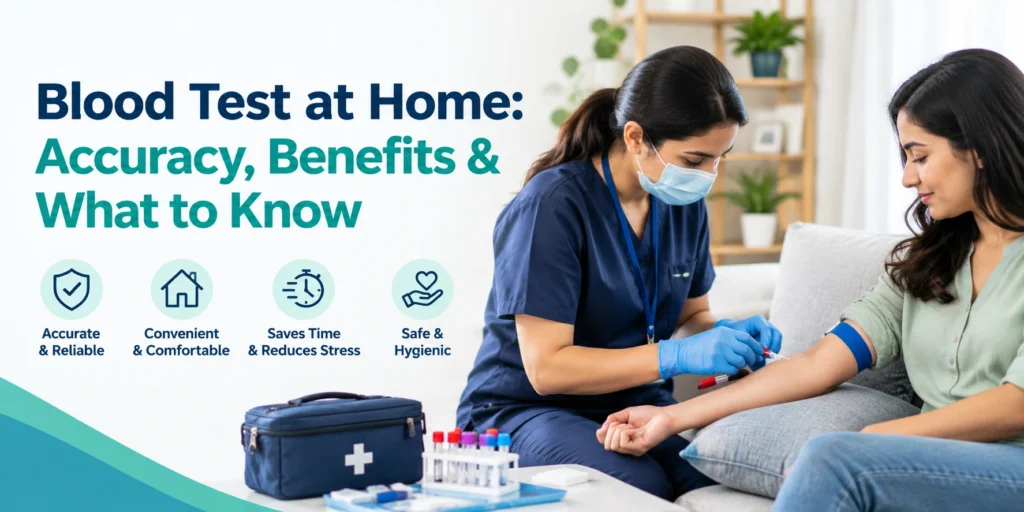
Getting a blood test used to mean the same tired routine: take time off, drive to the lab, sit in a room full of other people also waiting for their turn, get poked, and then wait around some more just in case there’s a queue for the receipt. In 2026, a lot of people have simply stopped doing that. A trained phlebotomist comes to you, draws the sample in your own kitchen or living room, and the results show up on your phone. For many people, a Blood Test at Home has become a much easier alternative to the traditional lab visit.
This isn’t a small trend, either. India’s diagnostics market is expected to cross ₹1.1 lakh crore in 2026, and home collection has gone from being a nice-to-have to something people just expect. As one industry report put it bluntly: labs that can’t offer home collection, even in smaller towns, are going to lose patients to the ones that can.
But the question people actually want answered before they book is simple: is it as good as going in person? Let’s get into it honestly.
What’s Actually Different (and What Isn’t)
A home blood test means a certified phlebotomist someone specifically trained to draw blood comes to your house, office, or wherever suits you, using the same sterile, professional-grade equipment they’d use in a lab. Your sample then goes to the same accredited lab it would have gone to anyway.
Traditional Lab Visit | Blood Test at Home | |
Where you get poked | The lab itself | Your home, office, wherever you choose |
Where it’s processed | The lab | The same accredited lab |
Wait time | However long the queue is that day | A set appointment window |
Accuracy | Standard lab accuracy | Identical, assuming proper collection |
Travel | Required | None |
Best fit for | Anyone who can easily get there | Elderly patients, anyone with mobility issues, busy people, contagious patients, families testing together |
The short version: nothing about the actual test changes. What changes is where the needle happens.
What Tests You Can Actually Get Done This Way
Most of the common ones, honestly:
- Complete Blood Count (CBC)
- Blood sugar — fasting, post-meal, or HbA1c
- Cholesterol and triglycerides
- Liver function
- Kidney function
- Thyroid panel
- Vitamin D and B12
- Hormonal tests
- Some infectious disease screening, depending on local regulations
- Full-body health checkup packages
A few tests that need very precise timing — like a glucose tolerance test that requires multiple draws over a couple of hours — need a bit more coordination. Worth asking your provider directly if your test falls into that category.
Okay, But Is It Actually as Accurate?
Yes — when it’s done properly, which it usually is. Here’s the thing people sometimes miss: accuracy comes down to the collection technique and how the sample’s handled afterward, not the address where the needle went in. A trained phlebotomist follows the exact same sterile procedure whether you’re in a clinic or on your own sofa.
What actually determines accuracy, regardless of location:
- Following fasting rules properly — if the test needs 8-12 hours of fasting, that matters wherever the draw happens
- How the sample’s transported — reputable services use proper cold-chain handling to keep the sample stable
- Correct tubes and labeling — this is standard procedure, not something home services skip
- Whether the lab itself is accredited — check for NABL accreditation in India, or your country’s equivalent
One thing worth being clear about: this is different from those self-administered finger-prick kits you might buy at a pharmacy. Those can genuinely have accuracy issues, since results depend heavily on how carefully the user follows instructions. A professional phlebotomist drawing your blood and sending it to an accredited lab doesn’t carry that same risk.
Booking One: What Actually Happens
- Pick the test or package you need.
- Check if it requires fasting, and for how long.
- Book a slot — early mornings tend to fill up fast for fasting tests, for obvious reasons.
- Give your address and contact details.
- The phlebotomist shows up with sterile, pre-labeled kits.
- The actual draw takes maybe five to ten minutes.
- The sample gets transported properly to the lab.
- Your report lands digitally, usually within 6-24 hours depending on the test.
- If you want, you can book a follow-up call with a doctor to actually talk through what the results mean.
What This Costs
- A single basic test — CBC, glucose, that kind of thing — is usually priced close to what you’d pay walking into a lab.
- Bundled health packages tend to work out cheaper per test than booking everything separately.
- Some providers add a small home-collection fee; others just build it into the package price.
- If you want a doctor to walk you through your results afterward, that’s often an optional add-on.
A tip that actually saves money: if more than one person in the house needs testing, book everyone together. A lot of providers drop the per-person price for multi-member bookings.
Who This Genuinely Makes Life Easier For
- Elderly patients who find getting to a lab physically exhausting
- Anyone with a disability that makes travel difficult
- Busy professionals who can’t spare the time during work hours
- Parents testing young kids, who are usually far less anxious getting tested at home than in a clinical setting
- People managing chronic conditions who need frequent monitoring — diabetes, thyroid, kidney issues
- Immunocompromised or contagious patients who genuinely shouldn’t be sitting in a public waiting room
- Families or offices doing a group health checkup together
Picking the Right Package
Package | What’s included | Good for |
Basic health check | CBC, glucose, lipid profile | General annual screening |
Diabetes panel | Fasting/post-meal glucose, HbA1c | Ongoing diabetes monitoring |
Thyroid panel | TSH, T3, T4 | Thyroid tracking |
Senior citizen package | CBC, kidney and liver function, thyroid, vitamin D/B12, cardiac markers | Preventive care for older adults |
Full body checkup | 40-90+ parameters | Comprehensive annual screening |
Women’s health package | Hormonal panel, thyroid, iron, vitamins | General reproductive and wellness screening |
What to Actually Check Before You Book
- Is the phlebotomist background-checked and wearing visible ID when they show up?
- Do they open a sterile, single-use needle in front of you and dispose of it properly?
- Is the processing lab accredited (NABL or your country’s equivalent)?
- Is your data encrypted and handled according to proper data protection rules?
- Can you access your report through a secure app or portal, not just a random email link?
How Technology’s Actually Changing This
- Smarter scheduling that matches phlebotomists to nearby bookings, cutting down wait times
- Real-time tracking of sample temperature and transit, so nothing degrades on the way to the lab
- AI flagging abnormal results and suggesting relevant follow-ups
- Platforms that connect your blood test results straight to a doctor consultation, so you’re not left staring at numbers with no context
- Predictive recommendations based on your test history, nudging you toward screenings before something becomes a problem
For what it’s worth, Amazon expanding into home diagnostics across several major Indian cities in 2026 is a pretty clear sign this has moved from niche convenience to mainstream infrastructure.
Questions People Actually Ask
Does it hurt more than a lab draw? No — same needle, same technique, same trained professional. The only thing that’s different is the address.
Do I still need to fast? Yes, if the test requires it. Fasting rules don’t change just because you’re at home.
How long until I get results? Most routine tests come back digitally within 6-24 hours. More specialized ones can take longer.
Can I book this for a parent who lives alone? Yes — most services let you book on their behalf and get the report sent to you directly, which makes remote care coordination a lot easier.
Is it actually hygienic? A properly run service uses single-use sterile equipment and follows the same infection-control standards as any accredited lab.
Conclusion
A blood test at home isn’t a compromise done through a proper phlebotomist and an accredited lab, it’s the same test, same accuracy, minus the waiting room. It’s especially worth it if you’re elderly, managing a chronic condition, testing multiple family members, or just genuinely can’t spare the time for a lab visit. The only real homework on your end is checking that the phlebotomist is verified and the lab is accredited; everything else is just convenience.
Ready to skip the queue? [Book a home blood test →]