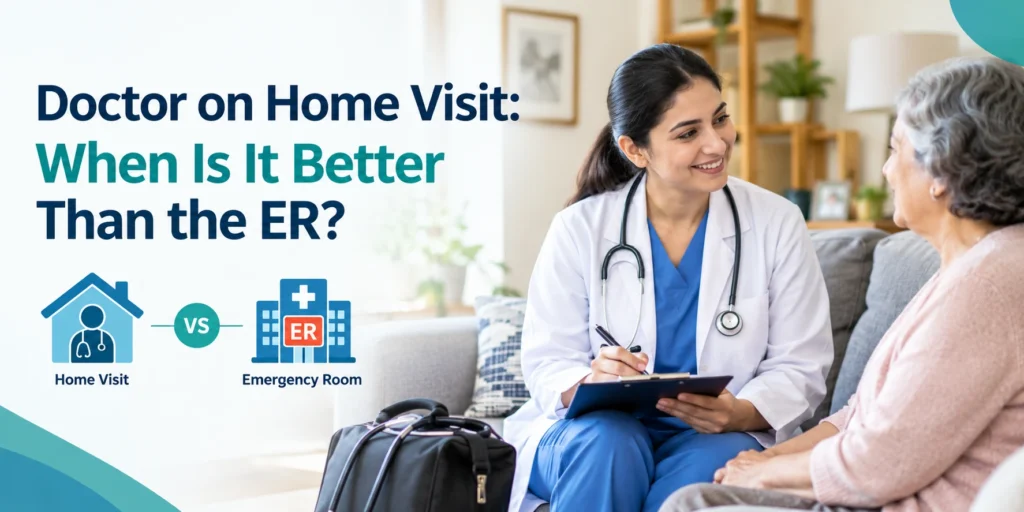
You know the moment. Your kid’s forehead is burning up, or your dad’s suddenly dizzy and unsteady, and you’re standing there at 2 a.m. trying to decide: is this an emergency room situation, or can it wait until morning? There’s actually a third option a lot of people don’t think of in the moment calling a doctor on home visit who can come to you within a couple of hours and give you an actual answer instead of a guess.
This has stopped being a niche service. As home healthcare has become more normal, more people are realizing this is often the calmer, more sensible choice for the huge middle ground of symptoms that are worrying but not life-threatening especially with kids and elderly parents, and especially outside normal clinic hours when your usual doctor isn’t reachable.
Here’s how to actually think about it: when it makes sense, how the whole thing works, roughly what it costs, and maybe most importantly how to tell the difference between “call a home visit doctor” and “go to the hospital right now.”
What This Service Actually Is
A doctor-on-home-visit service sends a licensed physician to your home, usually same-day or within a few hours, to look at something that’s bothering you enough to need a professional but isn’t clearly an emergency.
It’s a bit different from booking a regular physician home visit for an ongoing condition like diabetes management — this is more reactive. Something’s come up today, and you don’t want to wait in a clinic line to find out if it’s serious.
People usually call for things like:
- A sudden high fever, in a kid or an adult
- Vomiting, diarrhea, or looking a bit dehydrated
- A suspected infection — throat, ear, urinary tract, a skin issue
- A cut, sprain, or minor injury
- A mild allergic reaction
- Getting sick right after travel
- Flu or something contagious, where you’d rather isolate than sit in a waiting room
- Just a general “something’s not right” feeling that doesn’t obviously scream ER
The Question That Actually Matters: Home Visit or Hospital?
This is the call that matters most, and it’s worth having a clear framework in your head before you’re panicking at midnight.
Situation | Home Visit Works | Go to the ER |
Fever, no breathing trouble | Fine | Not usually necessary |
Vomiting/diarrhea, mild dehydration | Fine | Only if it’s severe |
Minor cuts, sprains, bruises | Fine | Only for deep wounds or suspected fractures |
Chest pain or pressure, trouble breathing | No | Go now |
Facial drooping, slurred speech, sudden weakness | No | Call emergency services immediately |
Throat or face swelling from an allergic reaction | No | Go now |
Bleeding that won’t stop | No | Go now |
Loss of consciousness | No | Call emergency services |
If you’re genuinely unsure and the situation feels like it’s getting worse, don’t try to save time by calling a home-visit doctor — go to the hospital or call emergency services. That’s not being overly cautious; it’s just the right call.
What Actually Happens When You Call
- You book through an app, a website, or a phone call, and describe the symptoms as clearly as you can.
- Most services now do a quick triage step first sometimes AI-assisted, sometimes a nurse on the phone mainly to catch anything that actually needs the ER instead of a home visit.
- You get matched with a nearby physician and a rough arrival window.
- The doctor examines you at home — vitals, physical exam, questions about history and symptoms.
- You get a diagnosis and a treatment plan on the spot, including medication if it’s appropriate and they have it with them.
- A digital prescription gets sent to your phone, often with delivery options for the medicine.
- If it needs more than they can handle at home, they’ll refer you onward — a specialist, a hospital, or maybe just a blood test to confirm something.
- If you want, the visit notes get shared with your regular doctor, so nothing falls through the cracks.
How Fast Can Someone Actually Get There?
Honestly, it depends on a few things:
- Time of day — daytime calls move faster than 2 a.m. ones, unsurprisingly
- Where you are — dense cities tend to have better coverage than smaller towns or rural areas
- How busy things are — flu season or a local outbreak can stretch response times
- What tier of service you book — some platforms let you pay a bit more for priority dispatch
Most decent urban services aim for somewhere between one and three hours for a standard call. That’s not instant, but it beats an ER waiting room most nights.
Before the Doctor Shows Up, Have This Ready
- A rundown of symptoms and when they started
- Current medications and any allergies
- Relevant medical history — surgeries, chronic conditions, recent hospital visits
- A thermometer reading, if you’ve got one
- Somewhere reasonably quiet and well-lit for the exam
- Insurance details, if that’s relevant to you
- Any recent test results connected to the issue
What It’ll Cost You
The pricing usually breaks down into a few pieces:
- A base fee for the consultation itself
- A late-night or early-morning surcharge, if that’s when you’re calling
- Sometimes a travel charge, depending on distance and city
- Extra for any on-site testing — ECG, glucose check, oxygen levels
- Medication, usually billed separately unless it’s bundled in
Good services will show you the price upfront before the doctor even leaves for your place. If a provider won’t give you a straight number before booking, that’s worth noticing.
Why This Has Become So Common, So Fast
A few things are pushing this trend at once. Traffic and city congestion make even a “quick” clinic trip eat up half a day when you’re sick. Healthcare costs are pushing people to be more deliberate about when they actually need an ER versus a targeted, cheaper alternative. Post-pandemic habits made remote and at-home care feel normal in a way it didn’t before. And frankly, the logistics of matching a doctor to a patient nearby, tracking arrival times are just easier to run now than they were a few years ago. On top of all that, more people are managing health at home generally, rather than defaulting to hospitals for things that don’t need one.
Choosing a Provider You Can Actually Trust
- Check that the physicians are actually licensed — most medical councils have a public registry.
- Look for pricing that’s clear before you commit, not after.
- Look at actual response-time reviews, not just star ratings.
- Ask what diagnostic equipment they carry.
- Find out if they can set up follow-up care — a blood test, a prescription delivery, a referral — if needed.
- Read recent reviews specifically for punctuality and professionalism, not just overall sentiment.
Conclusion
A doctor on home visit is built for the situations that sit in the middle — too concerning to ignore, not severe enough for an ambulance. It’s not a substitute for emergency care, and it shouldn’t be treated like one. But for fevers, minor injuries, infections, and the general “something’s off” moments that hit at inconvenient hours, it’s often faster and calmer than an ER trip. Just make sure whoever you book with is upfront about pricing and licensed to practice, and you’ll be fine.
FAQs
Search for "doctor home visit" plus your city or locality name on the website/app of a home healthcare provider, or call/WhatsApp their booking line directly. Most platforms let you enter your address or pin code to instantly check which doctors are available nearby and their estimated arrival time — typically 30–90 minutes for standard bookings, faster for urgent requests in well-covered metro areas.
Several home healthcare platforms operate across Delhi NCR, including Dwarka, Rohini, Saket, Vasant Kunj, Lajpat Nagar, Connaught Place, and extending to Gurugram, Noida, Ghaziabad, and Faridabad. Booking is usually done via app, website, or a direct call/WhatsApp number, and most providers respond within 15 minutes to a few hours depending on urgency. When choosing a provider in Delhi, check their exact locality coverage (some cover only specific NCR zones) and confirm whether pricing is a flat fee or varies by time of day.
Across Indian cities, a standard general physician home visit typically costs ₹500–₹3,000, with most falling in the ₹800–₹1,900 range. Pricing depends on:
- City: metro cities (Delhi, Mumbai, Bangalore) tend to price higher than Tier-2/3 cities
- Time of day: some providers charge flat rates 24/7, while others add night/weekend surcharges
- Doctor type: general physician visits are cheapest; pediatric, geriatric, and specialist visits cost more
- Add-ons: injections, IV fluids, ECGs, or lab sample collection are usually billed separately
Always ask for the full, all-inclusive price before confirming, since some providers advertise a low "starting from" fee that excludes travel or after-hours charges.
Nationally, home visit consultation fees generally range from ₹500 on the low end to ₹3,000+ for specialists or emergency visits. A rough breakdown:
- General physician: ₹500–₹1,500
- Pediatrician: ₹800–₹1,800
- Elderly/geriatric care visit: ₹1,000–₹1,800
- Specialist (cardiologist, etc.): ₹1,500–₹2,500+
Transparent providers include travel and GST in the quoted price; it's worth confirming this upfront to avoid surprise charges.
There isn't one universally "best" app, since coverage and quality vary sharply by city and locality. When evaluating apps, prioritize: verified coverage in your specific area (check before downloading), transparent pricing shown before booking confirmation, doctor qualification details (MBBS, registration number, years of experience), real-time ETA tracking, and independent app-store reviews rather than only in-app testimonials. Many providers also allow booking without an app, via phone or WhatsApp.
Many home healthcare providers offer dedicated geriatric/elderly-care visit options, distinct from general physician bookings, which typically include chronic disease monitoring (diabetes, hypertension, arthritis), mobility and fall-risk assessment, medication review, and coordination with family caregivers. Search for "geriatric home visit" or "elderly care doctor at home" plus your city, and confirm the provider has geriatric-trained doctors rather than only general physicians handling elderly cases.