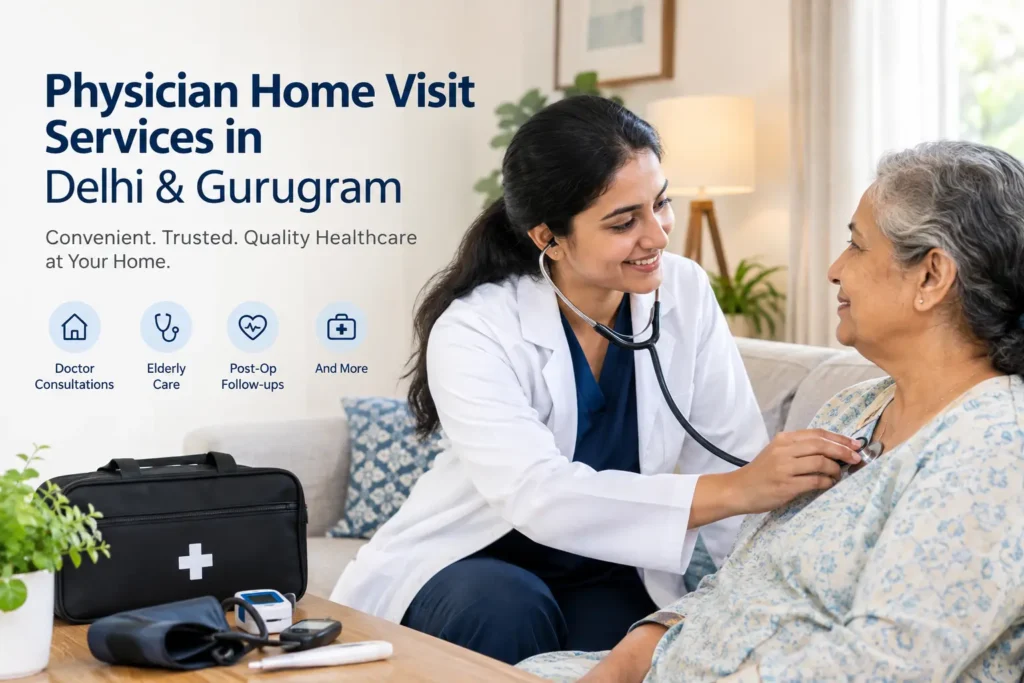
If you’ve ever sat in a crowded clinic waiting room with a feverish toddler, or worried about driving an elderly parent through Delhi NCR traffic just for a routine check-up, you already understand why physician home visit services have quietly become one of the fastest-growing parts of urban healthcare in India. What used to be a rare, expensive house-call arrangement is now a same-day, app-bookable service available across Delhi, Gurugram, and most other major Indian metros.
This guide walks through what a physician home visit actually involves, why demand is surging in the Delhi-Gurugram belt specifically, what it costs, how to pick a trustworthy provider, and where the industry is headed in 2026. Whether you’re a first-time caregiver trying to figure out your options or a working professional who simply doesn’t have three hours to spare for a routine consultation, this is meant to be a practical, no-fluff reference.
What Is a Physician Home Visit?
A physician home visit is exactly what it sounds like: a qualified, MBBS-registered doctor travels to your home to examine, diagnose, and treat you or a family member, instead of you traveling to a hospital or clinic. Most providers dispatch the doctor with a portable diagnostic kit — BP monitor, pulse oximeter, glucometer, thermometer, and basic wound-care supplies — so a large share of common issues can be handled on the spot.
In dense, traffic-heavy urban clusters like Delhi and Gurugram, this model solves a very specific pain point: getting timely medical attention without losing half a day to commuting, parking, and waiting-room queues.
How It’s Different From Telehealth
It’s worth being clear about this distinction, because the two are often confused:
| Aspect | Physician Home Visit | Telehealth / Video Consult |
|---|---|---|
| Physical examination | Yes, hands-on | No |
| Vitals check (BP, SpO2, sugar) | Done on-site | Self-reported by patient |
| Injections, IV, wound dressing | Possible | Not possible |
| Best for | Fever, infections, elderly care, post-op follow-up | Simple queries, prescription refills, second opinions |
| Response time | 30–90 minutes (urgent) | Minutes |
Why Demand for Physician Home Visits Is Rising in Delhi NCR
The Bigger Picture: A Fast-Growing Market
Industry market research reports covering the Indian home healthcare sector — including estimates from firms like IMARC Group, Grand View Research, Fortune Business Insights, and Mordor Intelligence — consistently point to strong double-digit annual growth for this industry through the early 2030s. Several 2026 estimates place India’s home healthcare market in the range of roughly USD 13–17 billion for the year, driven largely by an aging population, rising rates of chronic disease, and growing comfort with app-based, on-demand healthcare. Exact figures vary between research firms depending on methodology and what’s included in the “home healthcare” definition, but the direction is unanimous: home-based medical care remains one of the fastest-expanding segments of Indian healthcare, with Delhi NCR consistently named among the leading regional markets.
Why Delhi and Gurugram Specifically
Traffic and Time Poverty
Delhi and Gurugram routinely rank among India’s most congested cities. For working professionals and dual-income households, a 20-minute clinic consultation can easily become a 3-hour round trip once commute and wait times are factored in.
A Rapidly Aging, High-Density Population
Both cities have large populations of elderly residents whose adult children work long hours or travel frequently — a demographic that consistently drives the highest usage of home-visit and geriatric home-care services.
Post-Pandemic Comfort With Home-Based Care
The shift toward home diagnostics, home sample collection, and home-based recovery that accelerated after 2020 hasn’t reversed — if anything, it has matured into a standard expectation among urban Indian households.
Dense High-Rise and Gated Communities
Gurugram’s high-density residential sectors and Delhi’s gated colonies make it operationally efficient for providers to cluster multiple home visits in a single run, which in turn keeps response times short and pricing competitive.
What Services Are Typically Included
A comprehensive physician home visit generally covers a broad range of non-emergency medical needs.
Here’s a breakdown:
General & Acute Care
- Fever, viral infections, cold and flu
- Gastrointestinal issues (vomiting, diarrhea, mild dehydration)
- Minor injuries and wound care
Chronic Disease Management
- Diabetes monitoring and medication review
- Hypertension management
- Thyroid and other endocrine follow-ups
Elderly & Post-Operative Care
- Geriatric assessments, including mobility and fall-risk checks
- Post-surgical follow-up: suture removal, wound dressing, vitals tracking
- Coordination with the operating surgeon when complications arise
Pediatric Care
- Fever, cough, and cold in children
- Growth and vaccination-related consultations (provider-dependent)
Add-On Services (often available, usually priced separately)
- Home sample collection for lab tests
- ECG
- Injection and IV fluid administration
- Physiotherapy and nursing support
How a Physician Home Visit Works: Step-by-Step
The Typical Booking Journey
- Check availability — Enter your Delhi or Gurugram locality/pin code on the provider’s app or website to confirm coverage.
- Select consultation type — General physician, pediatric, elderly care, or specialist follow-up.
- Share symptoms — A short symptom summary helps the dispatcher match the right doctor.
- Confirm booking and payment — You’ll typically receive the assigned doctor’s profile and a live ETA.
- Doctor arrives and examines — Vitals check, physical examination, and diagnosis on-site.
- Digital prescription issued — Usually shared via WhatsApp or email within minutes of the visit.
- Follow-up scheduled if needed — Particularly important for post-operative or chronic care cases.
A typical consultation runs 20–40 minutes; visits involving procedures like IV administration or a detailed geriatric assessment can take 45–60 minutes. If you’d rather skip the research and just get a doctor to your door, you can schedule a home visit directly instead of comparing multiple platforms.
Cost of Physician Home Visits in Delhi & Gurugram (2026)
Pricing varies by provider, time of day, and whether add-on services are needed. Here’s a general reference range for the Delhi NCR region:
| Service Type | Approximate Cost Range (₹) |
| General physician consultation | 500 – 1,000 |
| Pediatric or elderly-focused visit | 1,000 – 1,500 |
| Specialist home consultation | 1,500 – 2,500+ |
| Night-time / emergency-hours visit | Higher than standard daytime rates |
| Add-ons (injection, IV, ECG, sample collection) | Charged separately
|
Tip for families: If you anticipate multiple visits — for example, an elderly parent’s chronic condition plus occasional pediatric visits for children — a subscription or family package is usually more cost-effective than paying per visit, since these often bundle a set number of visits per month at a discounted rate.
Who Benefits Most From Physician Home Visits?
Elderly Patients
Home visits reduce fall risk, limit exposure to hospital-acquired infections, and let the doctor assess the actual living environment — medication storage, mobility hazards, and hygiene — something a clinic visit simply can’t offer.
Post-Operative Patients
Recovery at home with periodic doctor check-ins tends to reduce complications and unnecessary hospital readmissions, particularly for wound monitoring and infection detection.
Working Parents and Professionals
For a working parent in Gurugram managing both office hours and a sick child, a home visit removes the need to take half a day off for a routine consultation.
Patients With Mobility Limitations
Anyone managing arthritis, post-stroke mobility issues, or general frailty benefits enormously from not having to navigate stairs, transport, and clinic queues.
How to Choose the Right Home Visit Provider
Not all providers are equal, and the sector is still fairly fragmented. Use this checklist:
 Doctor credentials — Confirm MBBS qualification and State Medical Council registration.
- Coverage — Verify the provider genuinely operates in your specific Delhi or Gurugram locality (coverage maps can be inconsistent).
- Response time transparency — Reputable providers commit to a clear window (commonly 30–90 minutes for urgent requests).
- Pricing clarity — Ask for exact costs upfront rather than relying on “starting from” figures.
- Verified reviews — Check Google and app-store reviews rather than testimonials on the provider’s own website alone.
- Emergency escalation policy — A trustworthy provider will be upfront that severe symptoms (chest pain, breathing difficulty, unconsciousness) require an ER, not a home visit.
If you’re evaluating a provider’s doctor home-visit service for a parent with an ongoing condition, it’s worth asking specifically whether the same doctor can be assigned for repeat visits — continuity matters a great deal for chronic disease management.
What’s New in 2026: Industry Trends Worth Knowing
| Trend | What It Means for Patients |
|---|---|
| AI-assisted symptom triage | Faster, more accurate matching of patients to the right specialist before dispatch |
| Integration with wearables/remote monitoring | Doctors can review recent vitals trends (BP, glucose) during the visit itself |
| Digital health record integration (ABDM) | Prescriptions and visit history increasingly sync into a portable digital health record |
| Expanding insurance coverage | More insurers are beginning to reimburse home-based consultations, not just hospitalization |
| Subscription/family-care models | Flat monthly plans covering multiple visits are becoming standard for households with elderly members |
| Bundled diagnostics | Home sample collection is increasingly offered in the same visit as the consultation |
These shifts are steadily narrowing the gap between what a hospital OPD can offer and what’s achievable at home — for stable, non-emergency conditions.
When You Should NOT Book a Home Visit
This is important enough to call out clearly: home visits are designed for stable, non-emergency conditions. If you or a family member experiences any of the following, go directly to the nearest hospital emergency department or call an ambulance — do not wait for a home visit:
- Chest pain or pressure
- Severe difficulty breathing
- Loss of consciousness or fainting
- Signs of stroke (facial drooping, slurred speech, sudden weakness)
- Major bleeding or major trauma
- High fever accompanied by confusion
Home-visit doctors are equipped for diagnosis and treatment of common, stable illnesses — not for life-threatening emergencies.
Key Takeaways
- Physician home visits bring MBBS-qualified doctors, diagnostic tools, and treatment directly to your home, typically within 30–90 minutes for urgent requests.
- Delhi and Gurugram are seeing especially strong demand due to traffic, time constraints, an aging population, and dense residential clusters.
- Costs typically range from ₹500–₹2,500+ depending on the type of consultation, with family/subscription plans offering better value for recurring needs.
- Always verify doctor credentials, coverage, and independent reviews before booking — and remember that home visits are not a substitute for emergency care.
- The sector is evolving quickly in 2026, with AI-based triage, wearable integration, and expanding insurance coverage making home-based care increasingly capable and convenient.
Get a Doctor to Your Doorstep — Today
Whether it’s a sudden fever, ongoing elderly care, or post-surgical follow-up, you don’t need to spend your day navigating Delhi or Gurugram traffic for routine medical care. Schedule a home visit now and have a qualified physician at your door — often within the hour.
Have questions about coverage in your locality, pricing, or a specific medical condition? Contact us and our team will help you find the right care option for your family.